Posts

Week 2 - Plant Taxonomy

Hey everyone!

This past week, I completed my second project at Mpala. For these last seven days, I've been working in Dr. Melly's plant taxonomy lab. As a brief overview, Mpala is home to a Smithsonian ForestGEO plot, meaning that it is part of the "Global Earth Observatory" network. This network, which has been established by the Smithsonian, is comprised of 74 research sites that are meant to represent the global forest network. Each forest in the network undergoes a standard series of tests and measurements that allow for a comparative study of the world's forests. As stated by the ForestGEO website (found here: https://forestgeo.si.edu/), "Today, the intensity and scale of the network remains unprecedented in forest science. In addition to the tree censuses that track the growth and mortality of trees in every forest site, ForestGEO pursues several scientific initiatives to study carbon fluxes, the impacts of climate change on biodiversity, and forest function".

Of these research sites, Mpala is home to the largest of all the plots - spanning 150 hectares (most plots are 50 ha or smaller). Dr. Melly is a plant taxonomist who works on the Mpala plot, and his current research consists of building an inventory of all the vascular plants on the Mpala ranch. Dr. Melly estimates that there are over 600 individual species present on the ranch, and so although it is an enormous task, it will eventually provide an essential tool for evaluating the biodiversity and promoting conservation at Mpala.

The fieldwork for this project mainly consisted of Dr. Melly and I going out on Mpala and collecting plant samples from species that had not yet been collected (Image 1a). There is so much biodiversity at Mpala, that there were days where we wouldn't move more than 50 meters in four hours because of the volume of new species that we were finding. Once we identified a species that we had not previously collected, we would take pictures of each part of the plant, from the inflorescence, stem, leafs, root system and more (Image 1b). Once we had taken photographs of the plant's morphological features, we then tagged each plant with a unique ID (Image 2) and collected four samples to be preserved. 

Image 1a: Dr. Melly and I collecting plant samples from the Mpala ranch

Image 1b: Dr. Melly photographing one of the plant species we collected


Image 2: One of the plant tags used in plant ID: includes (in order from top to bottom), name of the PI, the plant species ID, and the date of collection

Once we had collected our samples, we returned to the lab each day to begin pressing the plants for preservation. After separating all of the tagged samples, some plant material is preserved in small bags with silica gel in order to preserve it for DNA analysis (Image 3). Sequencing the DNA of each sample is essential to determining the exact species of each plant and preserving a reference for future comparisons. I was able to see firsthand how essential the DNA analysis is, as Dr. Melly and I found a species in the Cyphostemma genus that we are hypothesizing is either a new species, or one that is previously undocumented in Kenya. In order to confirm this discovery, however, we have to send some of the material to a lab to determine its exact species ID through genetic analysis. 

Image 3: Bags filled with samples that are going to be sent off to a lab for DNA analysis

Using cardboard and newspaper, we flattened each plant within a large stack of samples by strapping the stack between two boards (Image 4). These stacks were then heated overnight in a large bag filled with silica gel in order to remove all of the moisture from the samples (Image 5). Once the samples are completely dried, they are able to retain their color and morphological properties for hundreds of years. For this reason, once they were fully preserved, the samples are labeled and packed in order to send one copy to the Smithsonian, one to the National Museums of Kenya, one to be kept at Mpala, and then finally one that will be left with Dr. Melly. 

Image 4a: One of our samples after being pressed overnight

Image 4b: The stack of samples pressed from one day of fieldwork

Image 5: Samples drying in the heated chamber

Dr. Melly and I spent a week collecting our samples, preserving them through pressing, sending them for DNA analysis, and entering the information we collected into a database that will eventually be used as a tool for conservation strategy at Mpala and beyond. Although sometimes the work was tedious, I was grateful to have the opportunity to work closely with Dr. Melly on such an ambitious contribution to the scientific community. 

Image 6: Dr. Melly and I working in the lab

This week, I'll be working in Patrick's plant physiology/photosynthesis lab, and I can't wait to get started. 

Until next time!

Charlie 


An Update in Pictures

Some pictures from the past few days:

Common reed frog relaxing on an acacia tree (this specific acacia tree will be the subject of a future blog post)

Tree hyrax in the Graham Library

Savanna elephant

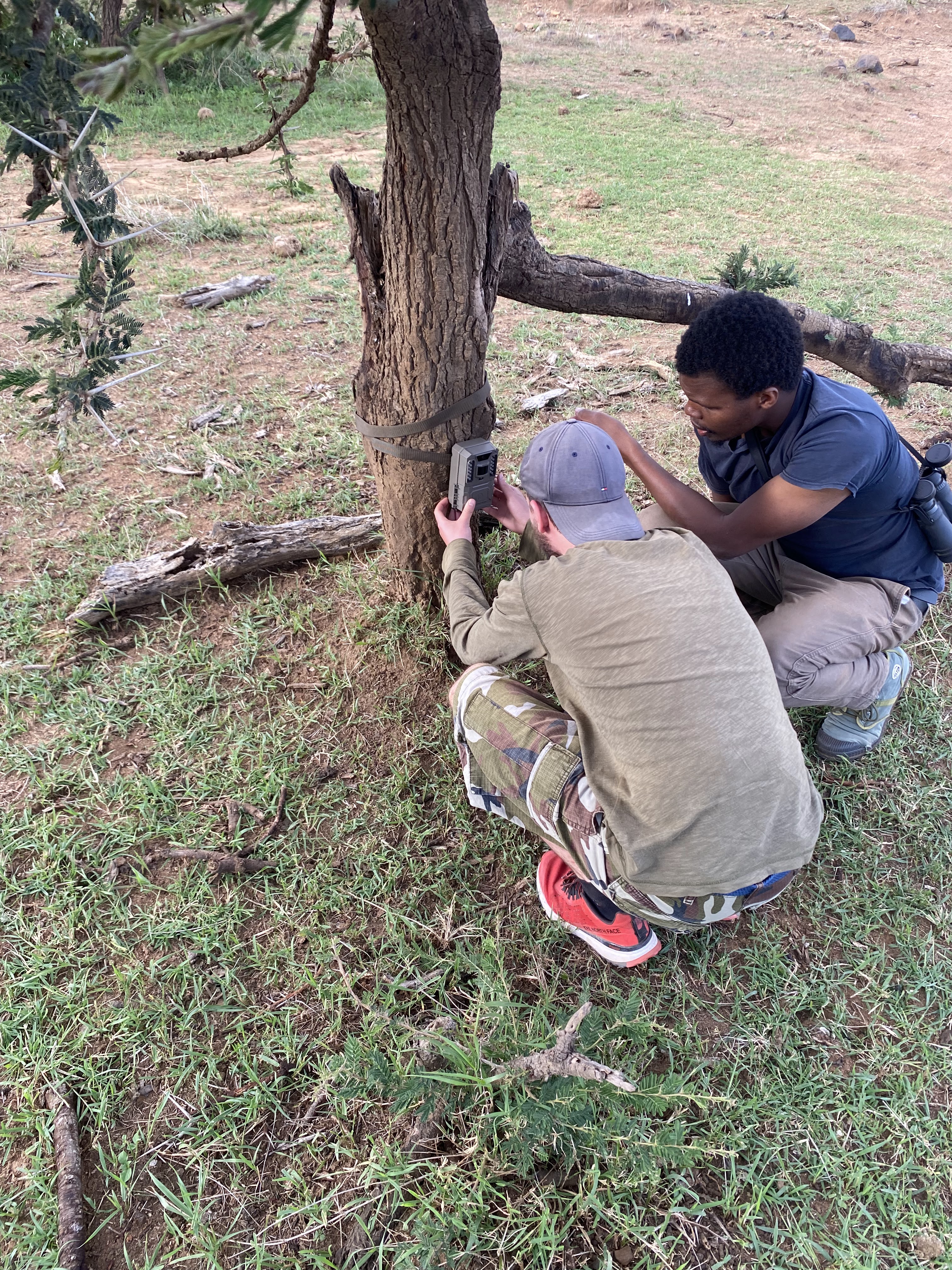
Tullio, Kennedy and me setting up a camera trap

Series of small pools that Tullio, Kennedy and I stumbled upon while setting up traps

The three of us heading to a local lookout

View from Eagle Scout lookout

Eastern chanting goshawk

African spoonbill fishing in a watering hole


My First Day Off - Hiking Mount Kenya!

After some last-minute chameleon identification and image uploading, I'm finally ready to share my experience this past week on Mount Kenya with you all!

June 1st was Madaraka Day in Kenya, which is a national holiday that commemorates Kenya gaining freedom/self-rule from the British in 1963 (this is separate from Jamhuri Day, which is in December and represents when Kenya officially gained independence and became a Republic - this happened about 6 months after they gained internal self-rule). Because it was a national holiday, I took a break from research and went on a hike to Mount Kenya with Dino! Mount Kenya was formed by a now extinct volcano (thankfully) and has the tallest peak in Kenya - reaching 5,199 meters. It has the second highest peak in all of Africa, only behind Kilimanjaro. You need to be a skilled rock climber to climb to the top of the mountain, so although we did not do that, it was really fun to hike up the rocky mountainside that was once an active volcano and now supports all kinds of life.

The drive up to the mountain was beautiful. On the way, I learned a lot about local agricultural, pastoral, and water distribution practices as we drove through the neighboring communities. Dino even showed me some of the farms that he has worked with to help them practice more sustainable agricultural practices such as drip irrigation and planting native species among the crops to promote pollination. 

Once at the base of the mountain (and after a whole ordeal where we had to do some convincing to let Dino take us up instead of a guide) we started driving through the different zones that makeup the ecology of the mountain. Mount Kenya is divided into 7 different zones (primarily due to the difference in altitude) that each support different flora and fauna. Each zone, from forests to afro-alpine zones, has distinctly different characteristics, and it was a bit surreal to drive through such different habitats within just minutes of each other. We also crossed the equator on the way up, moving from the northern to the southern hemisphere. Contrary to what they tell you, I felt like an entirely new person once I had passed into the southern hemisphere. I definitely got smarter and far more handsome (if you can even believe that's possible).

Before we officially started our ascent, we picked up a couple of travelers who were trying to avoid paying for a guide as well. They ended up being two assistant professors at the University of Amsterdam, where they study climate change disasters. This made for some interesting conversation about their work and its intersection with the ecology of eastern Africa. The four of us spent the whole day together and they were a great addition to the trip! For those of you who know Dino, you know that this also means that they got to take advantage of the walking encyclopedia that he is. While driving up the mountain to Old Moses camp (where we would park our car to start the hike), Dino spotted a von Hönel's chameleon on the road (pictured in Image 1) and stopped the car to run back and save it from getting run over. I still have no idea how he saw the chameleon, which was incredibly camouflaged with the road. From just the time he picked it up to when we had caught up with him, the chameleon had already begun to change its patters to adjust to its new environment. 

Image 1a: Me holding the von Hönel's chameleon

Image 1b: von Hönel's chameleon

After putting our new friend in a tree, we continued up to Old Moses to park the car. From there, we started our hike up Mount Kenya until we reached a weather station, which I learned is constantly sending out atmospheric data to different research institutions (Image 2). On the way up, Dino showed us many different species that are only found on the mountain, such as giant lobelias (Image 3), Jackson's francolin, and two different chameleon species (both the von Hönel's chameleon and the Mount Kenya hornless chameleon found in Image 4). The Mount Kenya hornless chameleon took camouflage to the next level, and was "waving" in the wind to give itself an even more convincing appearance of a leaf. Even though we could all tell the difference, you can't help but applaud the dedication and effort on the part of our new friend. Once we reached the weather station, we had climbed up to nearly 4,000 meters (or 12,000 feet). From there, we had an incredible view of Mount Kenya's two main peaks, Batian and Nelion (Image 5). According to Dino, the peaks are rarely this visible, so I felt very lucky to get to see them so clearly, even though the effects of climate change has left little snow on them. 

Image 2: Mount Kenya GAW station

Image 3: Giant lobelia 

Image 4: Mount Kenya hornless chameleon

Image 5: Our view of Mount Kenya's two largest peaks: Batian and Nelion

After our hike, we drove back down and explored a portion of the old growth forest found at a lower altitude on the side of the mountain (Image 6). It is immensely important to conserve these forests, as they play critical roles in maintaining natural cycles and providing ecosystem services. Their conservation is also imperative because if damaged, it takes hundreds and hundreds of years for them to regrow. As you can see in the image, these forests look a bit different because of the spacing between the trees. The trees have grown for hundreds of years, so even though they are spaced farther apart than the forests many of us are used to exploring, they have extensive canopies that cover the forest with shade. While exploring the forest, we saw tons of wildlife, but two of my favorites were the greenbul and Hartlaub's turaco (both bird species that are found in the area). After spending some time in the forest, we left the park and briefly stopped to observe a troop of baboons that were hanging out on the side of the road. In Image 7, you can see one of the young baboons hitching a ride on its mother's back. 

Image 6: Old growth forest on Mount Kenya

Image 7: Young baboon riding on its mother's back

Once we said goodbye to the baboons, we all left the park and returned to Cape Chestnut for a late lunch. Once again, Cape Chestnut provided one of the best meals I've had in a long time. Something that has struck me about my time here in Kenya so far is how fresh all the food is. It makes it hard to imagine returning to the global capital of processed foods when this is all over (and not all American restaurants have 5-10 dogs present at all times to keep you company, which is a major downside to returning to the states). Shortly after our meal, we dropped the Amsterdam professors off in Nanyuki where they were staying and started our journey back to Mpala. As usual, the drive back to Mpala was incredible, and as the sun was setting, we saw jackals and a giraffe eating some dinner off of an acacia tree (Image 8). 

Image 8: Reticulated giraffe feeding on an acacia tree

Overall, I had an amazing day hiking Mount Kenya with Dino (Image 9) and our two new Dutch friends. It was the perfect way to spend a day off, but I'm also excited to get back to work. In the couple of days I'll finish up my time working on the Vulturine guineafowl project, and transition into helping with the survey of vascular plants on the Mpala ForestGEO plot. 

Image 9: Dino and me on the side of Mount Kenya (with the peaks in the background)


Until then!

Charlie 


Week 1 - Vulturine Guineafowl Project

Instead of working on one project the whole time I'm here at Mpala, I am on a scientific "exposure tour", where I will be working with as many different researchers and projects as possible to gain experience in multiple different fields.

For my first week, I've been working on the Vulturine Guineafowl Project. This wildlife ecology project focuses specifically on the behavior, breeding, dispersal, and other ecological characteristics of the vulturine guineafowl (pictured below in Image 1). To gain some background in the basis of the project, I started my week by reading the master's and PhD theses of two scientists that have worked with the vulturine guineafowl at Mpala. One of those authors, Brendah, currently manages the project here, and has been a fantastic resource for me through this first week. 

Through reading both of the theses and learning from the researchers here on the project, I've learned that vulturine gunieafowl are unique in many ways, but some of the highlights are as follows:
  • Vulturine guineafowl live in stable groups that interact preferentially with other specific groups
  • They are the only known avian species to live in a multilevel/hierarchical society
  • While males typically stay in the same group for life, females leave their original group and find another group to join and breed
  • They breed during the wet season (I am here during the intermediate season, but even so, there has not been sufficient enough rains in Kenya for nearly 2 years to support breeding). 
  • They exhibit cooperative breeding, in which males from the group will help mothers raise their young. The males are usually not father of the young and help the more dominant females more than subordinate ones.
  • Cooperative breeding comes with large cost to the caregivers (losing up to 90% of foraging time) 


Image 1: Vulturine guineafowl at the "Airstrip" observation site


My main role on the project this week was getting out in the field and helping collect data in three major categories: movement, food abundance, and survey.

To collect movement data, some of the guineafowl are equipped with GPS "backpacks". These backpacks are solar powered, and charge during the day to keep recording data until the groups roost at night. In each group, about 1 out of every 10 guineafowl has been equipped with a GPS. In order to record the GPS movement data, another researcher (Wismer) and I went out at night from about 9:30 to 11 to download the GPS data from the roosting sites. Before heading out, we attach a large antenna to the back of the car (Image 2) and hook that antenna up to the GPS downloader (Image 3). We then drive by the sites where each group typically roosts, and once the GPS picks up the signal from the tag, we wait for the data to download. If there are any tags that are too far away for the antenna to pick them up from the road, there is a mobile antenna that we take up to "Lookout Rock" and point in every direction to pick up the signals from any remaining tags (Image 4). We can then bring this data back to the lab, upload it into Google Earth, and see a satellite representation of the exact path of each group throughout the day. This data is useful for studying range and dispersal as a response to climate change. As it gets hotter and food sources become increasingly scarce, the team has observed that the guineafowl have to expand their ranges in order to find adequate resources. 


Image 1: Wismer attaching the antenna to the back of the car


Image 4: GPS tool used to download data from each of the tags


Image 5: Picking up signals from Lookout Rock


To collect survey data, I went out with Brendah (the project coordinator) and Charolette (a post-doc working on the project) on multiple occasions to conduct evening surveys. As seen in Image 1, most of the guineafowl have four colored bands wrapped around their legs. Each combination of bands is unique to an individual. The groups of guineafowl are stable (as described above) and their roosting sites/range of movement are well documented. We were able to use this information go to different sites around the property and observe the groups, recording each individual present by the four band positions and colors (Image 6). Each guineafowl has a unique four-digit code associated with the colors banded to its legs. For example, if we observe a bird that has a green band above a yellow band on its right leg, and a red band above a blue band on its left leg, its unique ID would be GYRB. Besides providing helpful census data, this data collection can also help keep track of predation events and events when females move to different groups. If a male is not present in a group, it is likely that a predation event occurred, since males rarely leave their stable groups. If a female has left however, we can look for her in other groups to see if she has moved. 

Image 6: Recording sheet for census data


To collect food abundance data, I went out each morning at 6:30 am with Kenyan scientist, Kennedy, who is doing his master's thesis on the guineafowl. Kennedy had set up "pitfall traps" in different sites across the research center (traps pictured below in Image 7). The guineafowl primarily eat small insects on the ground, so each pitfall is designed for some of the insects present to fall in the traps as they move along the ground. There are pitfall traps at three different sites, with three kinds of habitat represented (grassland, bush, and heavy bush), and five traps at each individual habitat site (I'll do the math for you - that's 45 total traps).  Each morning, we would go out to collect the specimens from the traps and then bring them back to the lab to identify which food sources were available in each kind of habitat, and their abundance (Image 8). Each morning the traps brought about some kind of new surprise, but at the top of the leaderboard was definitely the scorpion that we found on the morning of May 31st (Image 9). Additionally, Kennedy sets out tarps at known roosting sites in order to collect samples of the bird's feces. He takes these samples and analyzes them using DNA metabarcoding to accurately identify what the guineafowl are eating. 
Another part of Kennedy's master's thesis involves guineafowl behavior when foraging, so I also helped him go out into the field and film the guineafowls as they foraged in different habitats, such as open grassland and heavy bush. In the afternoons, Kennedy and I went out and filmed individual guineafowls using the cameras seen in Image 10. After filming about 10 different individuals for one minute each, we would move on to a new habitat/group and do it again. This film is then reviewed, and Kennedy looks for factors such as time spent foraging and time spent in an "alert" position. These behaviors will then eventually be correlated with the food abundance data, linking them through each shared habitat. 

Image 7: Kennedy lifting one of the pitfall traps from the ground


Image 8: Kennedy and I going through the contents of each pitfall trap in the lab


Image 9: A scorpion that we found in one of the pitfall traps
Initial identification: Odunturus dentatus, also known as the "Kenyan deathstalker" - waiting on ID confirmation


Image 10a: Kennedy and I filming vulturine guineafowl behavior at the airstrip


Image 10b: Filming a group of vulturine guineafowl at the airstrip


Overall, I've had an incredible time working with the vulturine guineafowl team. They have all been incredibly welcoming and really helped me integrate seamlessly into the community here at Mpala. From working with them every day in the field and lab, to eating meals and exploring the grounds with them, I feel very lucky to have started my journey as a part of this team (pictured in Image 11). 


Image 11: The Vulturine Guineafowl Project team (plus Pat) at "Eagle's Spot" lookout:
From left to right: Kennedy, Monica, Mina, Tullio, Charlotte, Pat, Me


Tomorrow, I'll start working on the ForestGEO plot at Mpala. I'll provide more details on that project as the week goes on (mixed in with some of my favorite photographs).

About a week into this adventure, I continue to love every minute of it. 
Thank you all for following along! 

- Charlie


Blog Update + Some Babies and their Families

Hey everyone! 

Sorry for the lack of activity recently. I've been working on some posts that detail what projects I've been working on while here at Mpala, but I think from this point onward, I'm going to post a few pictures each day in between these "main posts". I've discovered that if I try to include all of the pictures I want to show you all in each of the main posts... it would take everyone about three days to finish reading each of them - so here is our compromise. 


Enjoy!


Two young plains zebras with members of their dazzle (which I've learned is what you call a group of zebras) behind them 

A family group of African savanna elephants

Young African savanna elephant 

Young baboon and its mother

Arrival at Mpala

Hello again everyone!

I have arrived in Kenya safely and after spending a day in Karen (a suburb of Nairobi), I am now at Mpala!


While in Karen, I stayed with one of my Uncle Dino’s friends, Steve. Steve is a lifelong butterfly researcher and houses a remarkable specimen collection. The collection accounts for over 95% of the total species of butterfly on the continent of Africa (Image 1a/1b) and plays an instrumental role in preserving the biodiversity of butterflies, as well as for conservation efforts such as the sequencing of butterfly genomes. While staying with Steve, I was also able to meet Dino’s friend, Paula. Paula is a filmmaker as well as elephant expert, and listening to the three of them talk over dinner is not something I will soon forget. 


Aside from the collection, Steve also houses one of the sweetest furry friends I have ever met: Borris. While only 24 hours into my journey, I have made two lifelong friends in Borris and Dudu (Dino's dog). As you can see in images 2a and 2b, both Borris and Dudu are very photogenic. 


After saying goodbye to Steve and Borris, Dino and I travelled North of Nairobi for about 5 hours to reach Mpala. We stopped at the Cape Chestnut restaurant on the way, where I was able to meet more of Dino’s friends who run the restaurant and are highly involved in the local community of Nanyuki (where the restaurant is also located). Although the meal at Cape Chestnut was delicious, it was the chocolate mousse that stole the show and gave us the energy to finish the drive.


After an incredible lunch, Dino, Dudu and I hopped in the car and finished the journey to Mpala. This last part of the drive left my jaw dropped so far to the floor that it was left dragging along the bumpy road. In just the 20 or so minutes spent on that road before arriving at Mpala, I saw baboons, dik diks, impalas, plains zebras, Grevy's zebras, vulturine guinea fowl (pictured in Image 3) and reticulated giraffes (a species of giraffe native to northern Kenya and pictured in Image 4). 


Once arriving at Mpala, Dino and I sat down for a cup of tea as we watched over the land from the back porch. After a few moments of enjoying the birds at the bird bath and the dik diks running through, a group of Grevy’s zebras came up to graze along the back porch. The Grevy’s zebra is an endangered species of zebra in Kenya and has different characteristics than the plains zebra that most people know. As pictured in Image 5, a plains zebra even came up with the group in order to allow me to show all of you how they are different. The most notable differences are that the plains zebra (left/below in Image 5) has stark, thick black and white stripes along its body and is smaller in stature compared to the Grevy's. The Grevy’s zebra on the other hand, has thinner and more uniform stripes than the plains zebra. The zebras also vary slightly in coloration, and the stripes of the Grevy’s zebra do not wrap all the way around its body (as you can see in Image 6), leaving a white belly exposed. Lastly, right before I went back to the dormitory to get settled in, I spotted a bush hyrax hiding in the rocks (Image 7). 


I know that looking back on this post in a few weeks, I will laugh at myself, knowing that this was just the tip of the biodiversity iceberg. Even that awareness, however, could not take away from the awe that I felt (and am still feeling) upon arrival. 


Until next time!


Charlie 


Image 1a: Dino walking along one of the many shelves in Steve's butterfly collection

Image 1b: One of the thousands of cases in the collection opened

Image 2a: Selfie with my friend Dudu

Image 2b: Selfie with my friend Borris

Image 3: Vulturine guineafowl  (male)

Image 4: Reticulated giraffe bull

Image 5: A plains zebra (left/bottom) and a Grevy's zebra (right/top)

Image 6: Grevy's zebra

Image 7: Bush hyrax peering at us over the rock